

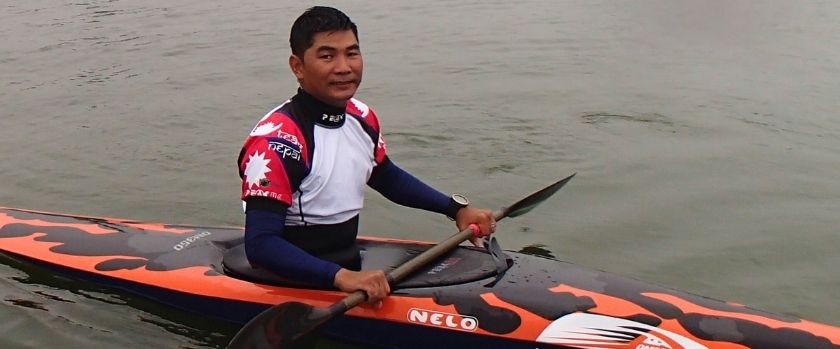
By 2014, Nim had firmly established himself as one of Nepal’s leading whitewater kayakers. Alongside Paddle Nepal’s raft team, which continued to dominate the Himalayan Whitewater Challenge, Nim was also claiming repeated individual kayaking victories.
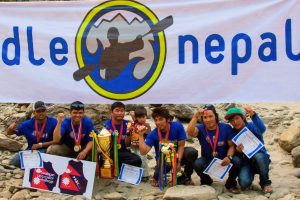 When we last left this story, Nim’s son Kailash was just a little boy proudly celebrating one of those victories alongside his father and the Paddle Nepal team. Those years of consistent success on Nepal’s rivers would earn Nim selection to represent Nepal, through the Nepal Olympic Committee, at the 17th Asian Games, organized by the Olympic Council of Asia (OCA), in Incheon, South Korea.
It was an extraordinary opportunity. But when Nim learned what the event involved, something felt strangely familiar.
Years earlier, he had travelled to France for his first international competition and arrived to find an unfamiliar boat, a different style of racing, and techniques he had barely encountered. While other athletes had trained specifically for the discipline, Nim found himself representing Nepal while simultaneously learning how to compete in the event.
Incheon would ask him to do much the same thing again.
This wasn’t traditional whitewater canoe slalom. The Asian Games featured a flatwater obstacle slalom course, beginning with a steep launch ramp before athletes navigated a series of slalom gates. While governed by the International Canoe Federation (ICF), it required a very different set of skills from the whitewater rivers on which Nim had learned to paddle.
There was no obstacle slalom course in Nepal, no coach with experience in the discipline, and no opportunity to practice the very event in which he was about to represent Nepal.
So, Nim did what he could.
He opened YouTube.
Watching video after video, he studied the unfamiliar techniques, trying to understand what awaited him on the other side of the world.
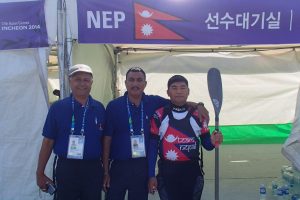 Nim travelled to South Korea with Nepalese delegates Surya Joshi and Kumar Ranabhat, arriving just three days before the competition. The short schedule meant missing both the Opening and Closing Ceremonies and left Nim only two days to prepare. The International Canoe Federation (ICF) supplied the competition boats, giving him just enough time to become acquainted with equipment he had never paddled before.
Then came the start ramp.
For most of the world’s competitors, launching from the elevated platform was simply part of the race. For Nim, it became the first challenge to overcome.
He remembers the first few attempts vividly. Sometimes he landed upside down, flipping immediately upon entering the water. Other times he stayed upright, only to discover he was pointing in entirely the wrong direction.
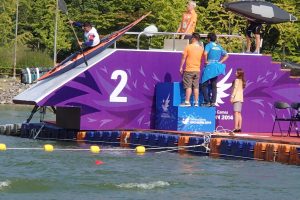
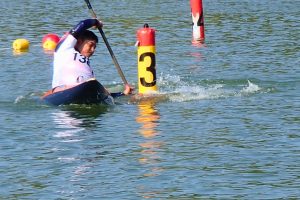
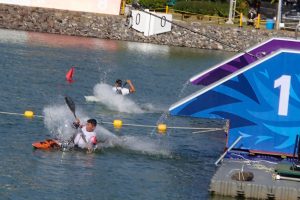
Even circling the slalom poles felt foreign. On Nepal’s whitewater rivers, reading currents and making decisive moves through rapids had become second nature. Flatwater obstacle slalom demanded a completely different style of precision and boat control.
Everything about the event was new.
And yet, this was exactly where he had been before—standing on unfamiliar ground, learning under pressure, and representing Nepal anyway.
Thanks to the generous support of Peak UK, who provided his Nepal team paddling gear, personal flotation device and paddle jacket, Nim proudly wore Nepal’s colours as he stood at the top of the start ramp, preparing to compete against Asia’s best.
The results themselves were only part of the story. Simply qualifying to stand on the start line of one of Asia’s largest multi-sport events was an honour few Nepali paddlers had ever experienced. The greater achievement was having the courage to stand on that start line at all.
Looking back now, the Asian Games wasn’t simply another competition. It was another reminder that representing your country doesn’t always begin with confidence or experience. Sometimes it begins with curiosity. Sometimes it begins with humility. Sometimes it begins by admitting you are the least experienced person in the field—and paddling anyway.
That willingness to become a student, even after years of success, has shaped so much of Nim’s journey.
From France…
to the World Championships…
to Incheon…
the destination may have changed, but the lesson has remained the same.
The greatest adventures rarely begin when we feel ready.
They begin when we are willing to take the first stroke into unfamiliar water.
Event Summary
Games: 17th Asian Games (Incheon 2014)
Host: Olympic Council of Asia (OCA)
Host City: Incheon & Hanam, South Korea
Games Dates: 19 September – 4 October 2014
Canoe/Kayak Competition: 27 September – 2 October 2014
Event: Men’s K-1 Canoe Slalom (Flatwater Obstacle Slalom)
Competition Dates: 1–2 October 2014
Venue: Hanam Misari Canoe/Kayak Center (Misari Regatta Course), Hanam, South Korea
Governing Federation: International Canoe Federation (ICF)
Representing: Nepal Olympic Committee
Field: 19 athletes from 13 nations
Result: Completed both runs; advanced to the repechage and finished 9th of 10 in the repechage after learning the discipline only days before competition.
This reflection is part of Paddle Nepal’s 20-year journey on Nepal’s rivers.