
After returning from Japan season after season, Nim continued building experience both abroad and in Nepal. When he was home, he freelanced as a river guide and trip leader, working with international companies and further deepening his reputation within the whitewater community.
At the same time, an idea had quietly begun to take shape — not just guiding for other companies, but creating something of his own.
It was something Nim had been thinking about for a long time.
He shared that dream with Kelly, and together they began talking about what it might look like. In those early days, Kelly’s role was small — helping with a name and a logo, and offering encouragement — while Nim continued to lead the vision forward.
And eventually, they came up with a name: Paddle Nepal.
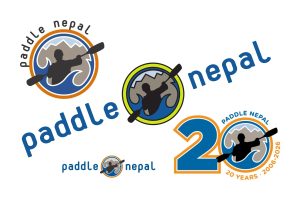 The first logo was created by Kelly’s brother, Keith, back in Canada. He jokes now that if he had known Kelly was going to marry Nim, he might have put a little more effort into it.
Over the years, the logo evolved — from its early lime and blue version to the orange and blue design that became more widely recognized. Recently, Keith returned once again to help redesign it for Paddle Nepal’s 20-year celebration.
The First Trip
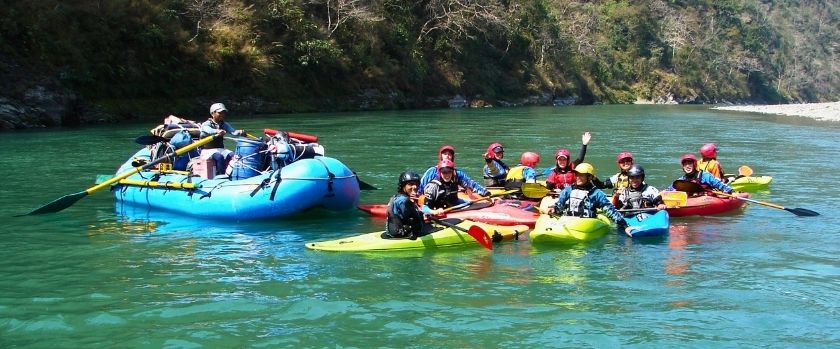
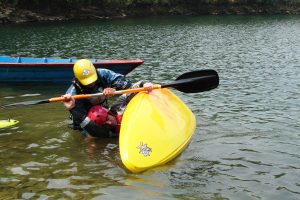 The very first Paddle Nepal trip was a kayak clinic for a group of Kelly’s volunteers from Kathmandu. A four day, learn to kayak program, starting on Phewa Lake in Pokhara, and continuing onto whitewater on the Lower Seti River. Kelly joined too.
There was just one small problem — she was terrified of the water.
An ironic detail, considering she had grown up on the beaches of Vancouver Island. Still, she was determined to try.
A few days into the four-day clinic, Nim finally looked at her and gently said, “You know… you don’t actually have to do this.” He could tell she was uncomfortable — terrified might be the more accurate word. But Kelly finished the clinic anyway.
She swam once — a moment Nim managed to capture on camera while his brother Som rescued her. She has 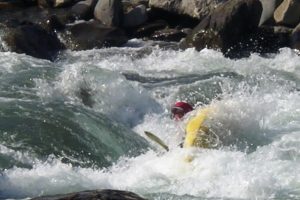 not kayaked on a river since.
In unexpected ways, that experience would quietly shape Paddle Nepal.
Not fear in a negative sense — but awareness.
A deep respect for the river and its risks.
Even then, there was a balance beginning to take shape — Nim’s confidence and experience on the water, alongside Kelly’s fear, and her instinct to question, to notice risk, and to think carefully about safety.
At the time, it wasn’t something they would have named or even noticed.
But looking back, those different perspectives would go on to shape how Paddle Nepal approaches rivers, guiding, and responsibility.
Starting with What He Had
Like many good adventure stories, Paddle Nepal began before everything was fully ready.
Nim ran that first trip using a fleet of kayaks he had won over the years through competitions, but beyond that there was very little equipment of his own.
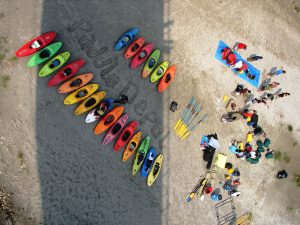 He bought what he could afford using savings from Japan and rented the rest — support rafts, tents, barrels, dry bags, and camping equipment. Much of it came from Charlie Dai at Ganesh Kayak Shop, another respected figure in Nepal’s early kayaking community and someone who strongly supported Nim in those early years. Years later, when Charlie retired and closed the shop, much of that equipment would eventually find its way to Paddle Nepal.
For that first trip, Nim was proud to employ a small team of close river guide friends, along with his brothers, Som and Santosh, who had followed in his footsteps and become professional river guides themselves. He hired a bus, and together, they made it happen.
There were no offices yet, no fleet of rafts, no kayak shacks by the lake, and no hotel in Pokhara — just experience, relationships, borrowed gear, and the willingness to begin.
Looking back now, it would have been easy to wait — for more money, more equipment, more certainty.
But Nim has always been someone willing to leap first and figure things out along the way.
And somehow, little by little, the net kept appearing.
It was a successful first trip.
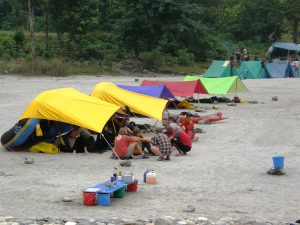 The clinic challenged each participant in different ways — building confidence, pushing comfort zones, and bringing the group closer together.
Friendships formed quickly on and off the river. Many of those volunteers have stayed in touch over the years, with some even returning to Nepal to visit.
That four-day kayak clinic has remained one of Paddle Nepal’s most popular programs — a simple format that continues to challenge, connect, and create lasting memories on the river.
(To be continued…)
This reflection is part of Paddle Nepal’s 20-year journey on Nepal’s rivers.