

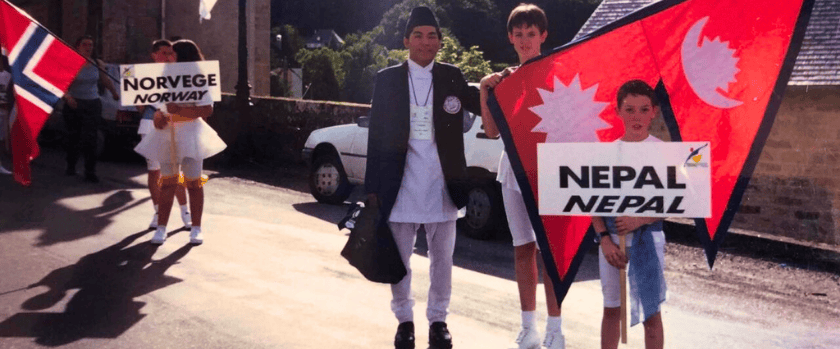
After navigating the train system in Paris and eventually reaching the competition venue in Treignac, France, Nim found himself surrounded by athletes from all over the world.
For the first time in his life, he was standing among international competitors — paddlers representing their countries, wearing national uniforms, carrying flags, and preparing for the opening ceremony of the World Championships.
Practice Before the Ceremony
For a few days before the opening ceremonies, athletes were given time on the river to practice.
The race was a downriver whitewater event on a dam-controlled section of river — normally considered Class II–III whitewater.
Most athletes arrived with their own modern carbon fibre boats. These were light, precise racing machines weighing around 10–12 kilograms.
Countries with fewer resources — including Nepal — were provided boats by the International Canoe Federation (ICF). These were heavy plastic models weighing closer to 22 kilograms — nearly twice the weight.
When Nim first sat in one of the boats, he was surprised by how unstable it felt compared to anything he had paddled before.
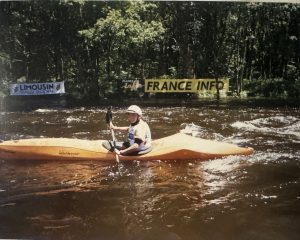 Strangely shaped.
Sensitive.
And incredibly tippy.
The river itself may have been considered moderate whitewater, but in that unfamiliar boat it felt more like Class IV–V. This made him very nervous.
During practice Nim found himself needing to roll several times — something he was fully capable of after years of paddling whitewater in Nepal. By this stage in his paddling; however, rolling was rarely necessary. Missing a line was uncommon. In the unfamiliar boat, even staying upright required constant focus and adjustment.
He certainly did not want to swim on race day.
Yet, just as he had done navigating the Paris train system, Nim did what he always does.
He adapted.
He practiced.
And he kept moving forward.
The Ceremony
Athletes gathered for the opening ceremony.
One by one, each country was introduced. As every nation stepped forward, their national anthem was played.
Flags were raised.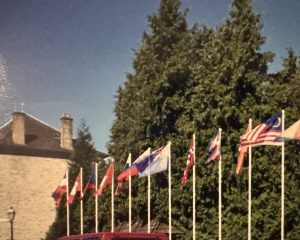
Teams stood together.
The atmosphere was proud and celebratory.
When Nepal was announced, Nim stepped forward.
But the anthem never came.
Nim stood there anyway.
The moment passed quietly.
Athletes around him began asking questions. Why had Nepal’s anthem not been played? Many said they had been curious to hear it.
Standing there, representing Nepal alone on the world stage, Nim felt the weight of the moment deeply. He felt incredibly sad — and quite exposed.
After hearing the questions from other athletes, organizers from the International Canoe Federation eventually called Nim into a meeting. He learned that the organizers had contacted the Nepalese embassy in Paris in advance, requesting a copy of the national anthem. It had never been sent.
They apologized for not having been able to play Nepal’s anthem.
Race Day
Despite the unfamiliar equipment and the emotional weight of the ceremony, Nim still had a race to paddle.
For many athletes it was just another competition.
For Nim, it was something entirely new — and at times intimidating.
A new country.
New equipment.
New river.
New expectations.
The river may have been considered Class II–III, but in the unfamiliar plastic boat it demanded complete focus. At one point during the race Nim had to roll again, but he recovered and kept going — never swimming.
And when the race was finished, Nim was far from first — but he was not last.
For someone paddling unfamiliar equipment on a foreign river, representing his country alone for the first time, simply finishing strong was its own quiet victory.
(To be continued…)
This reflection is part of Paddle Nepal’s 20-year journey on Nepal’s rivers.